
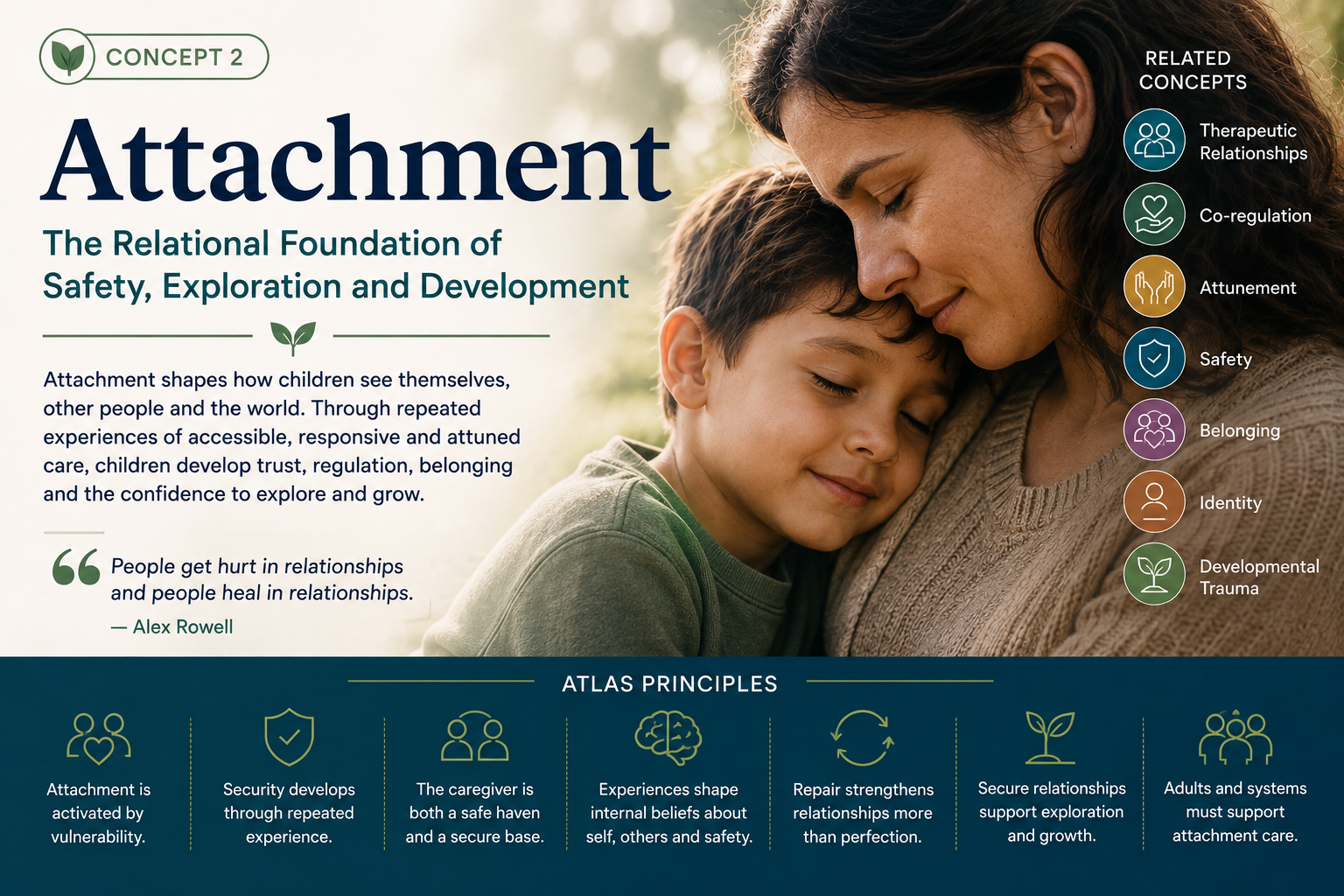
At a Glance
| Key Questions | Answers |
|---|---|
| What is attachment? | A biologically based relational system that motivates children to seek protection, comfort and support from familiar caregivers when they feel vulnerable or distressed. |
| Why does it matter? | Repeated attachment experiences shape children’s expectations about their own worth, the availability of other people and whether the world is safe enough to explore. |
| What do the contributors agree on? | Attachment security develops through repeated experiences of accessible, responsive and emotionally attuned care rather than through reassurance, affection or placement type alone. |
| What is unique about this Atlas page? | It connects foundational attachment theory with therapeutic care, internal working models, supervision, containment, education, lived experience and the realities of foster, kinship and residential child care. |
Atlas Navigation
You are here: Human Development → Attachment
| Related Concepts | Related Atlas Domains |
|---|---|
| Attachment Security | Relationships |
| Therapeutic Relationships | Therapeutic Practice |
| Co-regulation | Organisations |
| Attunement | Systems |
| Accessibility and Responsiveness | Lived Experience |
| Belonging | Research and Evidence |
| Identity | |
| Developmental Trauma | |
| Containment | |
| Therapeutic Parenting | |
| Internal Working Models |
Quick Facts
| Atlas Domain | Human Development |
|---|---|
| Related Domains | Relationships · Therapeutic Practice · Organisations · Systems · Lived Experience |
| Status | Core Atlas Concept |
| Primary Contributors | 10 |
| Contributing Voices | 20+ and growing |
| Podcast Episodes | Linked through contributor profiles |
| Key Quotations | Growing |
| Books Referenced | Growing |
| Research Base | Attachment Theory · Developmental Psychology · Developmental Psychopathology · Trauma Theory · Interpersonal Neurobiology |
| First Published | August 2026 |
| Last Updated | Automatically updated |
The Relational Foundation of Safety, Exploration and Development
Definition
Attachment is a biologically based relational system that motivates children to seek proximity to familiar caregivers when they feel frightened, distressed, unwell, uncertain or overwhelmed.
The purpose of attachment behaviour is care and protection.
When an attachment figure is accessible and responsive, the child is helped to recover from distress. As the child becomes calmer, attention can return to play, learning, relationships and exploration. In this way, the attachment figure functions both as a safe haven during distress and as a secure base from which the child can engage with the wider world.
Attachment is not simply closeness, affection or dependence. It is an organised developmental process through which children learn:
- whether other people will respond when needed
- whether distress can be managed
- whether relationships are safe
- whether they are worthy of care
- whether the world can be explored with confidence
These expectations become increasingly internalised. John Bowlby described them as internal working models. Within the Secure Start Atlas, they are also referred to as attachment representations: beliefs and expectations concerning the self, other people and safety in the world.
Attachment representations may include beliefs such as:
- I am worthy of care.
- Other people are dependable.
- My needs matter.
- Distress can be relieved.
- Relationships can survive difficulty.
- The world is sufficiently safe to explore.
Where attachment experiences have been inconsistent, frightening, rejecting or unavailable, children may develop very different expectations:
- I must manage alone.
- Other people cannot be trusted.
- My needs overwhelm or repel people.
- Closeness is unsafe.
- I must remain vigilant.
- I will eventually be rejected.
- The world is dangerous and unpredictable.
Attachment therefore concerns far more than how a child behaves towards a caregiver. It concerns the developing psychological organisation through which the child approaches relationships, vulnerability, help, separation, exploration and safety.
Atlas Summary
Attachment provides one of the central developmental foundations of therapeutic care.
Across conversations in The Secure Start Podcast, contributors repeatedly describe children as developing through experiences of being protected, emotionally understood, regulated and held in mind by trustworthy adults. Attachment theory provides a framework for understanding how these experiences become organised into expectations about the self, others and the wider world.
The Atlas also highlights important limits and cautions.
Attachment theory should not be used as a simplistic system for labelling children, blaming caregivers or automatically preferring one placement type over another. Nor should complex behaviour be attributed to an assumed attachment style without careful assessment.
Attachment-informed practice is most useful when it encourages adults to ask:
- What does this child expect from relationships?
- What happens when the child becomes vulnerable?
- Can the child seek and use comfort?
- What does the child believe about their own needs?
- What relational experiences are being repeated?
- What new experiences might gradually support greater security?
Attachment security does not arise because a child is told that they are safe or loved. It develops through repeated experiences in which care is sufficiently accessible, understanding, responsive and attuned.
Why Attachment Matters
Attachment relationships organise development.
During the early developmental period, children depend upon caregivers to protect them and regulate experiences that they cannot yet manage independently. Hunger, discomfort, fear, separation and overstimulation can be overwhelming. The caregiver’s response helps transform those experiences from unmanageable states into experiences that can be survived, understood and resolved.
Through thousands of repeated cycles, children learn what happens when they are distressed.
When care is sufficiently consistent, they increasingly expect that:
- someone will notice
- someone will respond
- distress will pass
- their needs are legitimate
- closeness can be safe
- exploration can resume
These expectations free developmental energy.
A child who trusts that an attachment figure remains available does not need to devote constant attention to monitoring the relationship. They can play, learn, take manageable risks, develop friendships and engage with the world.
When attachment care is inconsistent, rejecting, frightening or inaccessible, the child must adapt.
Some children reduce their visible expressions of need because seeking comfort has not reliably helped.
Others intensify proximity-seeking, distress or demands because care has been unpredictable.
Some experience their attachment figure as both the person they need and a source of fear, creating profound conflict in the organisation of attachment behaviour.
These adaptations may continue beyond the original relationships in which they developed. Children can approach foster carers, residential workers, teachers, therapists and other adults according to expectations formed through earlier experience.
They may:
- reject adults before adults can reject them
- resist comfort while remaining highly distressed
- appear excessively independent
- monitor adults closely
- demand constant reassurance
- attempt to control relationships
- struggle with separation
- interpret ordinary limits as abandonment
- experience care as intrusive or unsafe
- test whether relationships will endure
These responses are not evidence that the child does not need relationships.
They often reveal how important—and how dangerous—relationships have become in the child’s experience.
Attachment-informed therapeutic care provides repeated opportunities for children to encounter something different: adults who remain accessible, thoughtful and emotionally present without becoming intrusive, punitive or overwhelmed.
Common Misconceptions
Attachment is one of the most influential ideas in contemporary child welfare and one of the most frequently oversimplified.
Attachment is not the same as love
A caregiver may love a child deeply while finding it difficult to respond consistently to the child’s distress. Attachment security is shaped not by affection alone, but by the child’s repeated experience of whether care is available, understandable and effective when needed.
Insecure attachment does not mean that no attachment exists
Children generally form attachments to familiar caregivers, including when care is inconsistent or harmful. The relevant question is not simply whether an attachment exists, but how the attachment system has become organised.
Attachment style is not a complete description of a child
Children are not reducible to categories such as secure, avoidant, ambivalent or disorganised. Their relational behaviour is influenced by context, development, current stress, temperament, culture, the particular relationship involved, and other attachment relationships.
Attachment patterns are not always fixed
Early experience is important, but development continues. New relationships, changing circumstances, therapeutic intervention and repeated secure-base experiences can influence attachment representations over time.
All meaningful relationships are not necessarily attachment relationships
Children may have many valuable relationships with teachers, mentors, peers, residential workers, relatives and community members. Some may become attachment relationships; others provide belonging, opportunity, guidance or social support without serving the same attachment function.
Closeness does not automatically indicate security
A child may remain constantly close to a caregiver because they are uncertain that the caregiver will remain available. Another child may appear highly independent while suppressing attachment needs. Observable distance or proximity must be understood in context.
Secure attachment does not mean the absence of distress
Securely attached children still become upset, angry, frightened and dependent. Security is reflected in their greater capacity to seek and use support, recover from distress and return to exploration.
Attachment theory does not prescribe one placement type
Attachment theory should not be used to assume that foster care is always preferable to residential child care, or that the existence of a relationship automatically determines the best placement. Placement decisions require consideration of the child’s full developmental, relational and therapeutic needs.
Attachment difficulties cannot be diagnosed from behaviour alone
Many behaviours associated with attachment difficulties can also arise from trauma, grief, disability, neurodevelopmental difference, anxiety, sensory needs or environmental stress. Specialist assessment is required where an attachment-related disorder is suspected.
Therapeutic care does not require one adult to meet every need
Children benefit from dependable attachment figures, but they also need wider networks of supportive adults, peers, family members, teachers and community relationships. Security should expand the child’s relational world rather than restrict it.
Attachment-informed practice is therefore not about placing children into fixed categories. It is about using developmental understanding to become more curious about how children experience vulnerability, care, dependence, separation and relational safety.
Atlas Principles
Across contributors to The Secure Start Podcast, several recurring principles emerge.
Attachment is activated by vulnerability
Children are most likely to seek attachment figures when they are frightened, distressed, ill, uncertain or overwhelmed. Their behaviour during these moments provides important information about what they have learned to expect from care.
Security develops through repeated experience
Attachment security is not created by verbal reassurance. It develops through countless experiences in which needs are noticed and responded to in sufficiently consistent and effective ways.
The attachment figure is both a safe haven and a secure base
Children need somewhere to return when distressed and somewhere from which they can explore. Protection and exploration are complementary developmental functions.
Co-regulation supports attachment security
Adults help children manage emotional and physiological states that they cannot yet regulate independently. Repeated co-regulation strengthens trust and contributes to the development of self-regulation.
Attachment experiences become attachment representations
Children gradually form beliefs about their own worth, the availability of others and safety in the world. These beliefs influence later feelings, expectations and behaviour.
Behaviour may protect the child from relational danger
Avoidance, control, clinginess, rejection and vigilance may represent adaptive strategies developed in response to earlier caregiving experiences.
Repair matters more than perfection
No caregiver is consistently attuned. Security develops through relationships in which misunderstanding and disconnection can be recognised and repaired.
Secure relationships support exploration rather than dependency
A secure base enables children to move outward into learning, friendships, play and independence because support remains available when needed.
Adults’ attachment experiences influence care
Caregivers, practitioners, supervisors and leaders bring their own expectations and defensive strategies into relationships. Reflective practice helps adults recognise how these patterns influence their responses.
Attachment-informed systems must support caregivers
Children are more likely to experience secure and responsive care when the adults around them are themselves supported, regulated and held within dependable relationships and organisations.
Primary Contributors
These contributors provide the principal foundations for the Atlas’s contemporary application of attachment to therapeutic care.
| Contributor | Principal Contribution | Atlas Profile | Podcast Episode |
|---|---|---|---|
| Alex Rowell | Attachment-based supervision and the supervisor as a secure base | 🔗 | 🎙 |
| Ben Perks | Secure, safe, seen and soothed relationships across family, school and community | 🔗 | 🎙 |
| Peter Wilson | Attachment, psychotherapy and understanding the child’s internal experience | 🔗 | 🎙 |
| Gareth K. Thomas | Therapeutic parenting, co-regulation and protecting caregiver–child relationships | 🔗 | 🎙 |
| Laura Steckley | The relationship between attachment, containment and the development of self-regulation | 🔗 | 🎙 & 🎙 |
| Richard Rose | Attachment, identity and meaning through Therapeutic Life Story Work | 🔗 | 🎙 |
| Robbie Gilligan | Secure relationships, ordinary development and networks of supportive adults | 🔗 | 🎙 |
| Vicki McKeown | Attachment, shame, self-worth and protective relational strategies | 🔗 | 🎙 |
| Louise Allen | Authentic caregiving relationships, belonging and emotional availability | 🔗 | 🎙 |
| Mary-Anne Hodd | The lifelong impact of dependable adults and ordinary relational moments | 🔗 | 🎙 |
(The links above will become active as contributor profiles are added to the Atlas.)
Representative Quotations
The Atlas will continue to build a library of quotations illustrating the meaning and application of attachment.
“People get hurt in relationships and people heal in relationships.”
Alex Rowell
🔗 Atlas Profile 🎙 Podcast Episode
“The supervisor serves as a secure base.”
Alex Rowell
🔗 Atlas Profile 🎙 Podcast Episode
“For children to flourish, they need to have those four S’s.”
Ben Perks, referring to children being safe, seen, soothed and secure
🔗 Atlas Profile 🎙 Podcast Episode
“Relationships are everything.”
Gareth K. Thomas
🔗 Atlas Profile 🎙 Podcast Episode
“Shame is part of our attachment system.”
Vicki McKeown
🔗 Atlas Profile 🎙 Podcast Episode
Areas of Convergence
Despite differences in professional discipline and theoretical orientation, contributors consistently describe attachment as a developmental process through which repeated relational experiences shape children’s expectations of themselves, other people and the wider world.
There is substantial agreement that:
- attachment behaviour becomes especially visible during distress and vulnerability
- children need adults who function as both safe havens and secure bases
- emotional availability matters more than physical proximity alone
- security develops through consistency rather than perfect caregiving
- co-regulation is one of the central processes through which security develops
- children’s relational strategies make sense in light of earlier experience
- attachment representations influence behaviour across settings
- avoidance and apparent independence may conceal considerable distress
- demanding or controlling behaviour may reflect uncertainty about caregiver availability
- new relational experiences can modify expectations over time
- adults need reflective support to provide secure-base care
- attachment theory should encourage curiosity rather than labelling
- attachment is relevant beyond parenting, including therapy, supervision, teams and organisations
- secure attachment supports exploration, autonomy and engagement with the world
Contributors also converge on a crucial ethical point: attachment theory should be used to deepen understanding of children’s experience, not to justify predetermined decisions or reduce complex lives to attachment labels.
Distinctive Perspectives
Alex Rowell: Supervision as an Attachment Relationship
Alex Rowell extends attachment theory beyond parenting and psychotherapy into professional supervision.
He describes the supervisor as a secure base from which practitioners can explore uncertainty, acknowledge mistakes, try new approaches and develop professional confidence. The supervisory relationship becomes more than a setting for administrative review or instruction. It becomes a relational environment in which the supervisee can experience emotional safety while confronting the vulnerability involved in therapeutic work.
Alex also highlights the importance of internalisation. Effective supervisors remain psychologically available after formal supervision ends. Practitioners may continue to ask themselves how a trusted supervisor would understand a situation or approach a difficult interaction. In this way, the supervisory relationship becomes incorporated into the practitioner’s developing professional identity.
His contribution demonstrates that attachment processes operate wherever vulnerability, reliance, exploration and development are present.
Ben Perks: Attachment Across Family, School and Community
Ben Perks emphasises that children’s need for safety, visibility, soothing and security extends across the environments in which they grow.
Family relationships are especially influential during early development, but schools and communities can also become powerful protective environments. When children do not consistently experience safety and emotional responsiveness at home, trusted teachers and community adults may provide important alternative experiences of being seen, supported and valued.
Ben’s perspective expands attachment-informed thinking beyond the private caregiver–child relationship. It invites societies to ask whether families, schools and communities are intentionally organised around children’s needs for safety, connection and developmental support.
Attachment security becomes not only a family concern, but a public-health and prevention priority.
Peter Wilson: Attachment, Curiosity and the Internal World
Peter Wilson brings attachment into dialogue with psychotherapy and reflective practice.
His work emphasises the importance of remaining curious about children’s internal experiences rather than becoming prematurely certain about the meaning of behaviour. Attachment theory supports questions concerning what the child expects from adults, what vulnerability means to them and what previous relational experiences may be coming alive in the present interaction.
Peter’s emphasis on “I don’t know” protects attachment-informed practice from becoming formulaic. The theory offers a framework for thinking, but it does not replace listening, observation or relationship.
Attachment-informed psychotherapy therefore involves creating a relationship in which the child can gradually experience themselves as held in another person’s mind without being defined or explained too quickly.
Gareth K. Thomas: Supporting the Attachment Figure
Gareth K. Thomas focuses attention on foster parents and other therapeutic caregivers.
His central message is that the caregiver is not merely a person implementing an intervention. The caregiver–child relationship is one of the primary settings in which healing occurs. Systems should therefore support caregivers as central therapeutic resources rather than treating them as problems when the work becomes difficult.
Gareth’s emphasis on protecting the relationship is particularly relevant to attachment-informed care. Decisions about schooling, behaviour, contact, consequences and professional intervention should be considered in light of their impact on the child’s relationship with the caregiver.
His work also reinforces the need for co-regulation. Traumatised children require adults whose own nervous systems are sufficiently supported and regulated to remain available during relational testing and distress.
Laura Steckley: Attachment, Containment and Internalisation
Laura Steckley connects attachment theory with containment and co-regulation.
She explains how children gradually internalise repeated experiences of another person receiving, tolerating and making sense of overwhelming emotional states. The child becomes increasingly able to manage experiences that previously required another person’s direct presence.
Attachment and containment can therefore be understood as related developmental processes. Both describe how relationships enable children to move from dependence upon external regulation towards greater internal capacity.
Laura also extends this process into teams and organisations. Adults are better able to contain children’s distress when they themselves work within relationships and systems that help them think, regulate and recover.
Richard Rose: Attachment, Identity and Life Story
Richard Rose demonstrates that attachment concerns not only safety and proximity, but also identity and meaning.
Through Therapeutic Life Story Work, children are helped to understand why significant relationships changed, why they entered care and why painful events occurred. Without coherent explanations, children may interpret separation and caregiving disruption as evidence that they were unlovable, dangerous or responsible for what happened.
Richard’s work helps transform these attachment-related meanings.
By placing the child’s voice at the centre and bringing together multiple perspectives, Therapeutic Life Story Work can reduce self-blame, strengthen relationships with current caregivers and help children develop more compassionate attachment representations.
Attachment in Practice
Therapeutic Parenting
Therapeutic parents seek to become accessible, understanding, responsive and attuned attachment figures.
This involves noticing both overt and disguised expressions of need. A child who rejects comfort may remain deeply distressed. A child who appears controlling may be attempting to manage uncertainty about adult availability.
Attachment-informed therapeutic parenting involves:
- responding to the need beneath behaviour
- remaining available without becoming intrusive
- using boundaries to communicate safety and responsibility
- preparing children for separation and change
- repairing relational ruptures
- supporting exploration and age-appropriate independence
- maintaining connection during conflict
- reflecting on the caregiver’s own emotional responses
The goal is not to force closeness. It is to create repeated experiences in which closeness, help and dependence become increasingly safe.
Foster and Kinship Care
Children entering foster or kinship care experience both the need for new caregivers and the loss, disruption or uncertainty associated with previous relationships.
Attachment-informed care recognises that children may feel loyalty, grief, anger, hope and fear simultaneously.
Carers require support to:
- tolerate rejection and testing
- understand contradictory behaviour
- avoid interpreting avoidance as a lack of need
- respond thoughtfully to separation distress
- support safe connections with birth family and culture
- avoid demanding gratitude or immediate affection
- provide reliable care without expecting rapid trust
- recognise that placement transitions can reactivate earlier losses
The child’s attachment to a new caregiver does not erase previous relationships. Therapeutic care must make room for complexity.
Residential Child Care
Residential child care can provide important attachment experiences without attempting to reproduce a conventional family.
Children may develop meaningful and enduring relationships with residential workers who provide safety, continuity, emotional availability and thoughtful care within everyday life.
Attachment-informed residential practice includes:
- predictable key relationships
- careful welcomes and transitions
- consistent routines
- emotionally available adults
- thoughtful responses to separation and staff change
- shared rituals and memories
- reliable return after conflict
- attention to endings
- continued connection where appropriate
Residential workers should not be discouraged from forming significant relationships through fear that children will become “too attached.” Children who have experienced relational disruption need good attachment experiences somewhere. The task is to develop relationships ethically, reflectively and within organisations capable of supporting continuity and appropriate boundaries.
Education
Schools can function as secure-base environments.
Teachers may become important adults for children whose attachment needs are not consistently met elsewhere. A predictable classroom, a trusted teacher and repeated experiences of being seen and supported can strengthen a child’s capacity to engage with learning.
Attachment-informed education involves:
- greeting children warmly and predictably
- recognising that learning depends upon felt safety
- interpreting help-seeking and avoidance developmentally
- providing reliable routines
- preparing children for staff absences and transitions
- supporting repair after conflict
- balancing exploration with access to adult support
- avoiding public shame
- understanding that apparent independence can conceal anxiety
The aim is not to turn teachers into therapists or substitute parents. It is to recognise that relationships influence children’s readiness to learn.
Psychotherapy
Psychotherapy may become an attachment relationship, particularly when a child experiences the therapist as a consistent, emotionally available and trustworthy adult.
This should not automatically be regarded as problematic dependence.
A secure therapeutic relationship can provide an important experience through which the child explores vulnerability, develops new meanings and internalises the experience of being thoughtfully held in another person’s mind.
Attachment-informed psychotherapy requires careful attention to:
- consistency and reliability
- boundaries
- breaks and endings
- rupture and repair
- the meaning of dependence
- the child’s expectations of rejection
- the therapist’s emotional responses
- how therapeutic security can support wider relationships rather than replace them
Supervision
Attachment-based supervision treats professional learning as relational.
The supervisor provides a secure base from which practitioners can bring uncertainty, mistakes, emotional reactions and difficult clinical experiences without expecting humiliation or rejection.
Supervision should support exploration rather than compliance alone.
Secure-base supervision includes:
- psychological safety
- emotional attunement
- reflective challenge
- tolerance of uncertainty
- repair following difficult feedback
- attention to parallel process
- developmentally appropriate support
- increasing autonomy over time
The goal is not permanent dependence upon the supervisor. It is the gradual internalisation of a reflective relationship.
Leadership and Organisations
Therapeutic organisations also have attachment-like functions.
Leaders influence whether staff experience the workplace as predictable, responsive and safe enough for vulnerability, reflection and learning. Staff who fear blame, rejection or humiliation are more likely to conceal mistakes, become defensive and rely on rigid practice.
Attachment-informed leadership involves:
- predictable communication
- dependable supervision
- visible support during difficulty
- proportionate responses to mistakes
- opportunities for repair
- clarity during organisational change
- support for exploration and professional growth
- containment for those who contain others
Organisations cannot expect staff to offer children secure-base relationships while providing staff with instability, fear and relational uncertainty.
Reflective Questions
- What happens when this child becomes frightened, uncertain or overwhelmed?
- Who does the child seek when distressed?
- Can the child use the comfort that is offered?
- Does the child minimise or conceal attachment needs?
- What does closeness appear to mean to this child?
- What does separation appear to mean?
- What beliefs might the child hold about their own worth?
- What might the child expect from adults?
- Does the child experience the world as safe enough to explore?
- What relational strategy may this behaviour be protecting?
- How do I respond when the child rejects, controls or clings to me?
- What feelings does the child evoke in me?
- Do my responses confirm or challenge the child’s expectations?
- How do we prepare the child for absences, endings and transitions?
- What opportunities exist for relational repair?
- Are we using attachment theory to understand the child or to justify a decision already made?
- What support do caregivers need to remain available and responsive?
- How does our organisation function as a secure base for staff?
Related Concepts
- Attachment Security
- Therapeutic Relationships
- Co-regulation
- Attunement
- Accessibility
- Responsiveness
- Internal Working Models
- Attachment Representations
- Belonging
- Identity
- Developmental Trauma
- Containment
- Reflective Practice
- Therapeutic Parenting
- Therapeutic Residential Child Care
- Rupture and Repair
- Psychological Safety
Contributing Voices
The following contributors broaden, deepen or complement the Atlas’s understanding of attachment through their work on relationships, trauma, care, identity, belonging, child development, organisations and lived experience.
- Adela Holmes
- Alan Jenkins
- Andrew Isaac
- Bruce Henderson
- Carla Keyte
- Emma Higgs
- James Anglin
- John Turberville
- John Whitwell
- Julie Taylor
- Kevin Gallagher
- Lisa Cherry
- Lisa Holmes
- Martha Holden
- Megan Corcoran
- Nimali Kumari
- Patricia Sheridan
- Paul van Heeswijk
- Peter Blake
- Richard Rollinson
- Ruth Clare
- Surja
- Tanja Abou
- Tom Ellison
(Each name will link to the contributor’s Atlas profile and podcast episode.)
Further Reading
Foundational Attachment Theory
Bowlby, J. Attachment and Loss, Volume 1: Attachment. London: Hogarth Press, 1969.
Bowlby, J. Attachment and Loss, Volume 2: Separation: Anxiety and Anger. London: Hogarth Press, 1973.
Bowlby, J. Attachment and Loss, Volume 3: Loss: Sadness and Depression. London: Hogarth Press, 1980.
Ainsworth, M.D.S., Blehar, M.C., Waters, E., and Wall, S. Patterns of Attachment: A Psychological Study of the Strange Situation. Lawrence Erlbaum Associates, 1978.
Main, M., and Solomon, J. “Procedures for Identifying Infants as Disorganised/Disoriented During the Ainsworth Strange Situation.” In Greenberg, M.T., Cicchetti, D., and Cummings, E.M. (eds.), Attachment in the Preschool Years. University of Chicago Press, 1990.
Cassidy, J., and Shaver, P.R. (eds.). Handbook of Attachment: Theory, Research, and Clinical Applications. Guilford Press.
Therapeutic and Applied Attachment Practice
Pearce, C. A Short Introduction to Attachment and Attachment Disorder, Second Edition. London: Jessica Kingsley Publishers, 2016.
Hughes, D.A. Attachment-Focused Parenting: Effective Strategies to Care for Children. W.W. Norton, 2009.
Golding, K.S. Nurturing Attachments: Supporting Children Who Are Fostered and Adopted. Jessica Kingsley Publishers, 2007.
Daniel, B., Wassell, S., and Gilligan, R. Child Development for Child Care and Protection Workers, Second Edition. Jessica Kingsley Publishers, 2010.
Rose, R. Life Story Therapy with Traumatized Children: A Model for Practice. Jessica Kingsley Publishers.
Related Therapeutic Care Literature
Anglin, J.P. Pain, Normality, and the Struggle for Congruence: Reinterpreting Residential Care for Children and Youth. Routledge, 2003.
Holden, M.J. Children and Residential Experiences: Creating Conditions for Change. Child and Family Press, 2009.
Emond, R., Steckley, L., and Roesch-Marsh, A. A Guide to Therapeutic Child Care: What You Need to Know to Create a Healing Home. Jessica Kingsley Publishers, 2016.
Perks, B. Trauma Proof: Healing, Attachment, and the Science of Prevention. Central Recovery Press, 2025.
This section will continue to expand to include:
- books written by contributors
- key attachment research
- systematic reviews
- practice guidance
- related Atlas concept pages
Atlas Insight
Attachment occupies a foundational position within the Secure Start Atlas because it connects children’s early relational experiences with their developing expectations of themselves, other people and the world.
Attachment theory helps explain why care is not experienced only in the moment. Repeated interactions become psychological expectations. Accessibility becomes an expectation that help will be available. Responsiveness becomes an expectation that needs can be met. Attunement becomes an expectation that inner experience can be understood. Repair becomes an expectation that relationships can survive difficulty.
These expectations influence how children approach every later relationship.
The Atlas also places attachment within a broader therapeutic landscape. Attachment does not operate separately from co-regulation, containment, shame, identity, belonging, trauma, neurodevelopment or organisational culture. These concepts describe overlapping dimensions of how people develop through relationships.
Perhaps the most important Secure Start contribution is the emphasis on attachment representations. What matters is not merely whether a child displays a particular pattern of behaviour, but what the child has come to believe:
- about their own worth
- about the availability and intentions of other people
- about whether vulnerability is safe
- about whether the world can be explored
Therapeutic care seeks to influence these beliefs through experience.
Children do not develop more secure attachment representations because adults persuade them to think differently. They develop them through repeated relationships in which they are protected, understood, responded to and held in mind.
Attachment-informed practice therefore asks adults and organisations to provide more than closeness. It asks them to create dependable relational conditions through which children gradually discover:
I am worthy of care.
Other people can be dependable.
My needs can be understood.
Distress can be managed.
Relationships can survive difficulty.
The world can become safer to explore.
Knowledge Evolution
The contemporary understanding of attachment has developed through contributions from psychoanalysis, ethology, developmental psychology, observational research, developmental psychopathology, trauma theory, neuroscience and relationship-based practice.
Within the Secure Start Atlas, attachment continues to evolve beyond the early caregiver–infant relationship into a broader framework for understanding therapeutic care, supervision, education, teams and organisations.
Evolution of the Concept
Early psychoanalytic foundations
Separation, dependency and the importance of early relationships
↓
John Bowlby
Attachment as an evolutionary system supporting protection and survival
↓
Mary Ainsworth
Safe haven, secure base and observational patterns of attachment
↓
Mary Main and Judith Solomon
Disorganised attachment and conflict within the attachment system
↓
Internal Working Models
The internalisation of beliefs about self, others and relational safety
↓
Developmental Psychopathology
Understanding attachment in relation to trauma, adaptation and developmental pathways
↓
Attachment-Focused Therapeutic Practice
Applying attachment principles in psychotherapy, foster care, adoption and parenting
↓
Attachment Across Contexts
Schools, residential child care, supervision, teams and organisations as secure-base environments
↓
Attachment Representations
Understanding how repeated care shapes beliefs about worth, others and safety in the world
↓
Secure Start Atlas Synthesis
Attachment as a developmental bridge connecting care, regulation, identity, belonging and exploration
Where Next?
Continue exploring:
→ Attachment Security
→ Therapeutic Relationships
→ Co-regulation
→ Attunement
→ Accessibility and Responsiveness
→ Internal Working Models
→ Belonging
→ Identity
→ Developmental Trauma
→ Containment
→ Therapeutic Parenting
→ Therapeutic Residential Child Care
This page is part of the Secure Start Atlas of Therapeutic Care.
The Atlas is a living knowledge resource developed from conversations on The Secure Start Podcast. As new contributors, research, ideas and lived experiences emerge, this page will continue to evolve.
