
At a Glance
| What are therapeutic relationships? | Purposeful relationships that promote healing, development and psychological wellbeing. |
| Why do they matter? | Children recover through repeated experiences of emotionally available adults. |
| What do the contributors agree on? | Relationships are the primary mechanism of therapeutic change. |
| What is unique about this Atlas page? | It synthesises the perspectives of more than fifty international contributors across psychology, residential care, foster care, education, leadership and lived experience. |
Atlas Navigation
You are here: Relationships → Therapeutic Relationships
| Related Concepts | Related Atlas Domains |
| Attachment | Human Development |
| Belonging | Therapeutic Practice |
| Co-regulation | Organisations |
| Containment | Lived Experience |
| Reflective Practice | |
| Therapeutic Parenting | |
| Therapeutic Residential Child Care | |
| Hope | |
| Organisational Culture |
Quick Facts
| Atlas Domain | Relationships |
|---|---|
| Related Domains | Human Development · Therapeutic Practice · Organisations · Lived Experience |
| Status | Core Atlas Concept |
| Primary Contributors | 10 |
| Related Contributors | 22 (and growing) |
| Related Podcast Episodes | 16+ |
| Key Quotations | 30+ |
| Books Referenced | Growing |
| Research Base | Attachment Theory · Developmental Psychology · Trauma Theory · Therapeutic Care |
| First Published | August 2026 |
| Last Updated | (Automatically updated) |
The Primary Context for Healing, Growth and Recovery
Definition
Therapeutic relationships are purposeful, developmentally informed relationships that promote healing, emotional growth and psychological wellbeing. Unlike relationships that exist solely to manage behaviour, provide treatment or deliver services, therapeutic relationships intentionally create the conditions in which children and young people can experience safety, trust, belonging, co-regulation and hope.
Across the Secure Start Atlas of Therapeutic Care, therapeutic relationships emerge as the single most consistent foundation of effective practice. Regardless of professional background or theoretical orientation, contributors repeatedly describe relationships—not programmes, techniques or interventions—as the primary context in which recovery occurs.
Atlas Summary
Therapeutic relationships are the organising principle of therapeutic care.
Across more than fifty contributors to The Secure Start Podcast, relationships consistently emerge as the primary context in which children experience safety, regulation, belonging, identity and hope. While contributors differ in their theoretical traditions and professional settings, there is remarkable agreement that meaningful and enduring relationships are more influential than isolated techniques or interventions.
This page brings together those perspectives, identifies their areas of convergence and difference, and explores what therapeutic relationships look like in everyday practice.
Why Therapeutic Relationships Matter
Children develop through relationships.
From infancy onwards, relationships shape how children understand themselves, other people and the world around them. Repeated experiences of safety, responsiveness and emotional availability help children develop trust, regulate emotion, explore confidently and build a coherent sense of identity.
Conversely, relationships characterised by abuse, neglect, rejection, inconsistency or loss may fundamentally alter children’s expectations. Children who have experienced developmental trauma often learn that adults are unpredictable, unavailable or unsafe. Their behaviour frequently reflects attempts to protect themselves from further disappointment or harm.
Therapeutic relationships seek to provide new relational experiences that gradually challenge these expectations.
Healing does not occur because adults explain to children that they are safe.
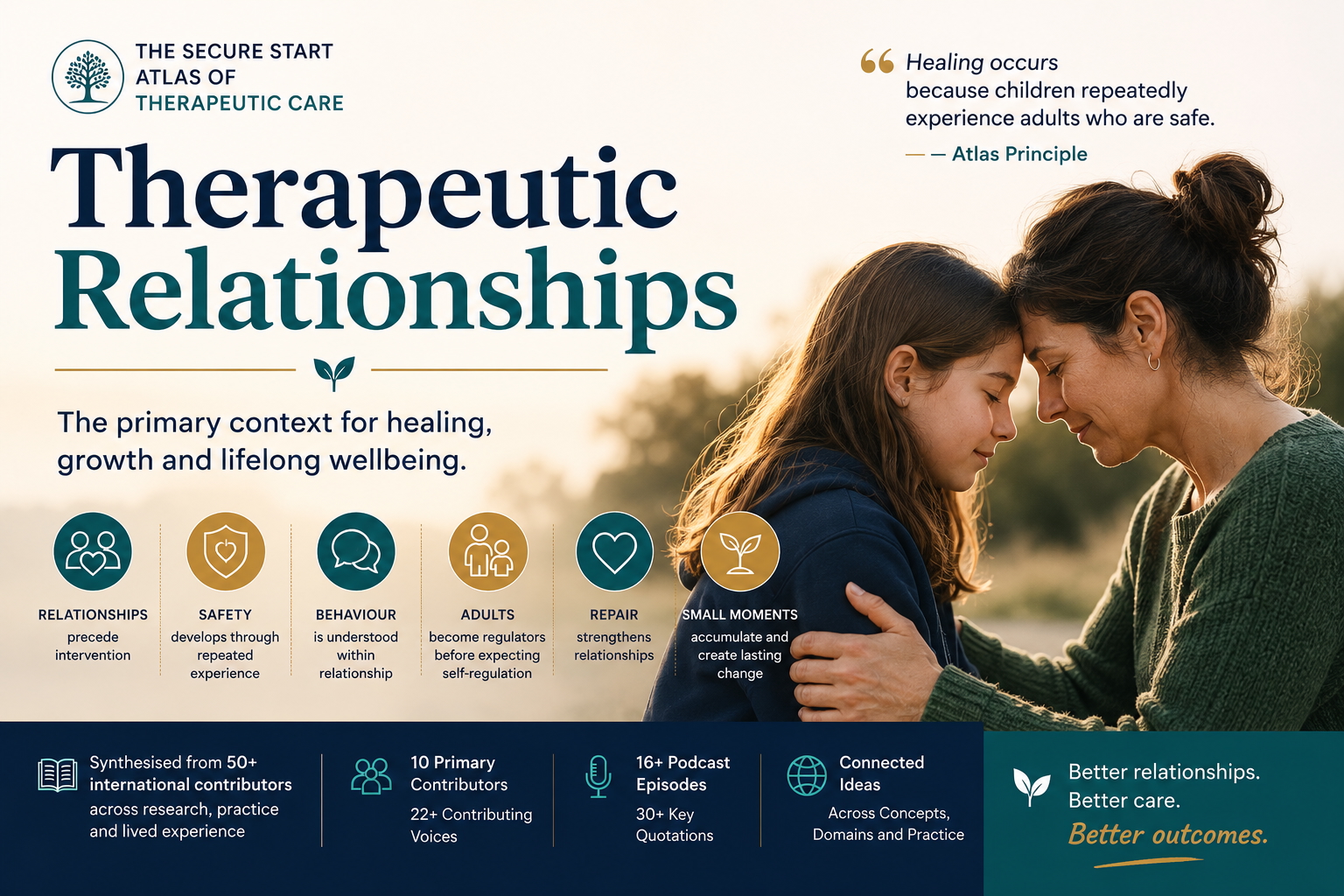
Healing occurs because children repeatedly experience adults who are safe.
Common Misconceptions
Therapeutic relationships are sometimes misunderstood as being simply about warmth, kindness or spending more time with children. While these qualities are important, contributors across the Secure Start Atlas consistently emphasise that therapeutic relationships involve much more than good intentions.
Therapeutic relationships do not mean:
- Being permissive or avoiding boundaries.
- Becoming a child’s friend rather than a trusted adult.
- Excusing harmful behaviour.
- Prioritising connection at the expense of safety.
- Believing that a single relationship can meet all of a child’s needs.
- Assuming that relationships alone are sufficient without thoughtful practice, organisational support and effective systems.
Instead, therapeutic relationships combine emotional availability with clear boundaries, curiosity, consistency, accountability and a commitment to supporting children’s development over time. They are purposeful relationships that help children experience safety, regulation, belonging and hope while promoting healthy development and responsible decision-making.
Atlas Principles
Across more than fifty contributors to The Secure Start Podcast, several recurring principles consistently emerge.
Relationships precede intervention.
Children are more likely to accept guidance, boundaries and support when they first experience genuine connection.
Safety develops through repeated experience.
Trust is built through consistency rather than reassurance alone.
Behaviour is understood within relationship.
Rather than asking “How do we stop this behaviour?”, therapeutic relationships ask “What is happening for this child within this relationship?”
Adults become regulators before expecting self-regulation.
Children borrow the emotional capacity of trusted adults before gradually developing their own.
Repair strengthens relationships.
Therapeutic relationships are not characterised by perfection but by the capacity to recover following misunderstanding, conflict or disappointment.
Small moments accumulate.
Ordinary interactions—a greeting, remembering a birthday, sharing a meal, sitting alongside a young person after a difficult day—often become the experiences children remember most clearly.
Primary Contributors
These contributors provide the principal foundations for the Atlas’s understanding of therapeutic relationships.
| Contributor | Principal Contribution | Atlas Profile | Podcast Episode |
|---|---|---|---|
| Robbie Gilligan | Ordinary relationships and networks for life | 🔗 | 🎙 |
| James Anglin | Therapeutic residential relationships | 🔗 | 🎙 |
| Martha Holden | Everyday life as therapeutic care | 🔗 | 🎙 |
| Laura Steckley | Containment and emotional availability | 🔗 | 🎙 & 🎙 |
| Peter Wilson | Understanding before intervention | 🔗 | 🎙 |
| Gareth K. Thomas | Therapeutic parenting | 🔗 | 🎙 |
| Mary-Anne Hodd | Small moments and belonging | 🔗 | 🎙 |
| Richard Rollinson | Presence and meaning-making | 🔗 | 🎙 & 🎙 |
| Lisa Holmes | Relationships as meaningful outcomes | 🔗 | 🎙 |
| Ruth Clare | Trusted adults and lifelong impact | 🔗 | 🎙 |
(The links above will become active as contributor profiles are added to the Atlas.)
Representative Quotations
The Atlas will gradually build a library of quotations illustrating each concept.
Examples include:
“Relationships are everything.”
Gareth K. Thomas
🔗 Atlas Profile 🎙 Podcast Episode
“The little things become really big things”
Mary-anne Hodd
🔗 Atlas Profile 🎙 Podcast Episode
“The group home fits me.”
James Anglin (quoting a young person)
🔗 Atlas Profile 🎙 Podcast Episode
“What made you grow up? It was knowing someone was there for you.”
Tanja Abou
🔗 Atlas Profile 🎙 Podcast Episode
“Relational stability is how we achieve better identity and belonging.”
Lisa Holmes
🔗 Atlas Profile 🎙 Podcast Episode
Areas of Convergence
Despite differences in professional background and theoretical orientation, contributors consistently describe therapeutic relationships as the primary context in which children experience safety, emotional regulation, belonging, identity formation and hope. While individual contributors emphasise different aspects of these relationships, there is remarkable agreement that healing occurs through repeated relational experiences rather than isolated interventions.
Contributors consistently emphasise that:
- Relationships are developmental.
- Relationships provide safety.
- Relationships support regulation.
- Relationships create belonging.
- Relationships build hope.
- Relationships require consistency.
- Relationships cannot be rushed.
- Relationships continue to matter long after formal services end.
Distinctive Perspectives
While broad agreement exists, contributors also enrich the concept in different ways.
James Anglin emphasises therapeutic relationships within an extra-familial living environment.
Laura Steckley explains how relationships provide emotional containment and restore thinking and purposeful action.
Peter Wilson focuses on curiosity, uncertainty and emotional understanding within psychotherapy.
Mary-Anne Hodd reminds us that ordinary moments often become the defining memories children carry throughout life.
Robbie Gilligan highlights the importance of helping children develop enduring networks of supportive relationships.
Gareth K. Thomas demonstrates that supporting caregivers is essential because therapeutic parenting depends upon emotionally available adults.
Therapeutic Relationships in Practice
Therapeutic Parenting
Relationships provide safety before correction.
Parents protect connection while maintaining thoughtful boundaries.
Foster and Kinship Care
Children require carers who remain available through testing, rejection and uncertainty.
Residential Child Care
Everyday life becomes therapeutic through consistent relationships rather than isolated interventions.
Education
Teachers often become the most stable adults in children’s daily lives.
School relationships may influence development as profoundly as formal therapeutic work.
Leadership
Therapeutic organisations depend upon leaders creating the same relational experiences for staff that staff are expected to provide for children.
Reflective Questions
- How does this child experience me?
- What expectations might this child hold about relationships?
- What experiences am I repeatedly providing?
- Does my response strengthen or weaken connection?
- What opportunities exist for repair?
- How am I contributing to this child’s sense of safety and belonging?
Related Concepts
- Attachment
- Belonging
- Co-regulation
- Containment
- Reflective Practice
- Therapeutic Parenting
- Therapeutic Residential Care
- Hope
- Emotional Regulation
- Organisational Culture
Contributing Voices
The following contributors broaden, deepen or complement the Atlas’s understanding of therapeutic relationships through their work on attachment, trauma, organisational leadership, education, lived experience and systems of care.
- Adela Holmes
- Adriana Dias
- Alex Rowell
- Andrew Isaac
- Ben Perks
- Bruce Henderson
- Carla Keyte
- Emma Higgs
- John Turberville
- John Whitwell
- Julie Taylor
- Kevin Gallagher
- Lisa Cherry
- Louise Allen
- Megan Corcoran
- Patricia Sheridan
- Paul van Heeswijk
- Peter Blake
- Richard Rose
- Surja
- Tom Ellison
- William Curran
(Each name will link to the contributor’s Atlas profile and podcast episode.)
Further Reading

Anglin, J.P. Pain, Normality, and the Struggle for Congruence: Reinterpreting Residential Care for Children and Youth. Routledge, 2003

Holden, M.J. Children and Residential Experiences: Creating Conditions for Change. Child and Family Press. 2009

Emond, R. Steckley, L. & Roesch-Marsh, A. A Guide to Therapeutic Child Care: What You Need to Know to Create a Healing Home. Jessica Kingsley Publishers, 2016

Wilson, P. The Adolescent and the PsychotherapistWhy ‘I Don’t Know’ Matters. Routledge, 2026

Rollinson, R. Some reflections on “towards belonging” for children in care: guided journey or “wandering lost”? Routledge, 2015

Child Development for Child Care and Protection Workers: Second Edition, Jessica Kingsley Piblishers, 2010
By Brigid Daniel, Sally Wassell, Robbie Gilligan

Henderson, B.B. Challenging the Conventional Wisdom about Residential Care for Children and Youth: A Good Place to Grow. Routledge, 2023

Clare, R. Enemy: a true story of courage, childhood trauma and the cost of war. Life Lab Books, 2023

Perks, B. Trauma Proof: Healing, Attachment, and the Science of Prevention. Central Recovery Press, 2025

Pearce, C. A Short Introduction to Attachment and Attachment Disorder (Second Edition). London: Jessica Kingsley, 2016
Holmes, L., Connolly, C., Mortimer, E., & Hevesi, R. (2018). Residential Group Care as a Last Resort: Challenging the Rhetoric. Residential Treatment For Children & Youth, 35(3), 209–224. https://doi.org/10.1080/0886571X.2018.1455562
Whittaker, J. K., Holmes, L., del Valle, J. F., Ainsworth, F., Andreassen, T., Anglin, J., … Zeira, A. (2016). Therapeutic Residential Care for Children and Youth: A Consensus Statement of the International Work Group on Therapeutic Residential Care*. Residential Treatment For Children & Youth, 33(2), 89–106. https://doi.org/10.1080/0886571X.2016.1215755
This section will expand over time to include:
- Books written by contributors
- Key research papers
- Influential theoretical works
- Related Atlas concept pages
Atlas Insight
Therapeutic relationships occupy a unique position within the Secure Start Atlas because they are not simply another concept—they are the thread that connects almost every other idea. Attachment develops through relationships. Co-regulation occurs within relationships. Containment is provided through relationships. Belonging is experienced through relationships. Hope is communicated through relationships. Even organisational culture ultimately shapes the quality of relationships available to children.
The diversity of contributors represented within the Atlas makes this convergence particularly striking. Researchers, practitioners, educators, organisational leaders and people with lived experience consistently return to the same conclusion: lasting therapeutic change is rarely produced by techniques in isolation. It emerges through ordinary, enduring, emotionally available relationships in which children repeatedly experience safety, understanding, reliability and genuine human connection.
Knowledge Evolution
The understanding of therapeutic relationships has developed through contributions from attachment theory, developmental psychology, therapeutic communities, residential care, foster care, psychotherapy and lived experience.
Within the Secure Start Atlas, this concept continues to evolve as new contributors expand our understanding of how relationships promote healing, development and lifelong wellbeing.
Evolution of the Concept
- Attachment Theory – John Bowlby, Mary Ainsworth
- Developmental Relationships – Donald Winnicott, Urie Bronfenbrenner
- Therapeutic Communities and Residential Care – James Anglin, Martha Holden
- Containment and Reflective Practice – Laura Steckley, Richard Rollinson
- Therapeutic Parenting – Gareth K. Thomas, Louise Allen
- Lived Experience – Mary-Anne Hodd, Ruth Clare, Tanja Abou, Surja, Nimali Kumari, Lisa Cherry
- Secure Start Atlas Synthesis – The collective perspectives of contributors to The Secure Start Podcast
Where Next?
Continue exploring:
→ Attachment
→ Belonging
→ Containment
→ Co-regulation
→ Reflective Practice
→ Therapeutic Parenting
→ Therapeutic Residential Care
→ Organisational Culture
This page is part of the Secure Start Atlas of Therapeutic Care.
The Atlas is a living knowledge resource developed from conversations on The Secure Start Podcast. As new contributors and new evidence emerge, this page will continue to evolve.