
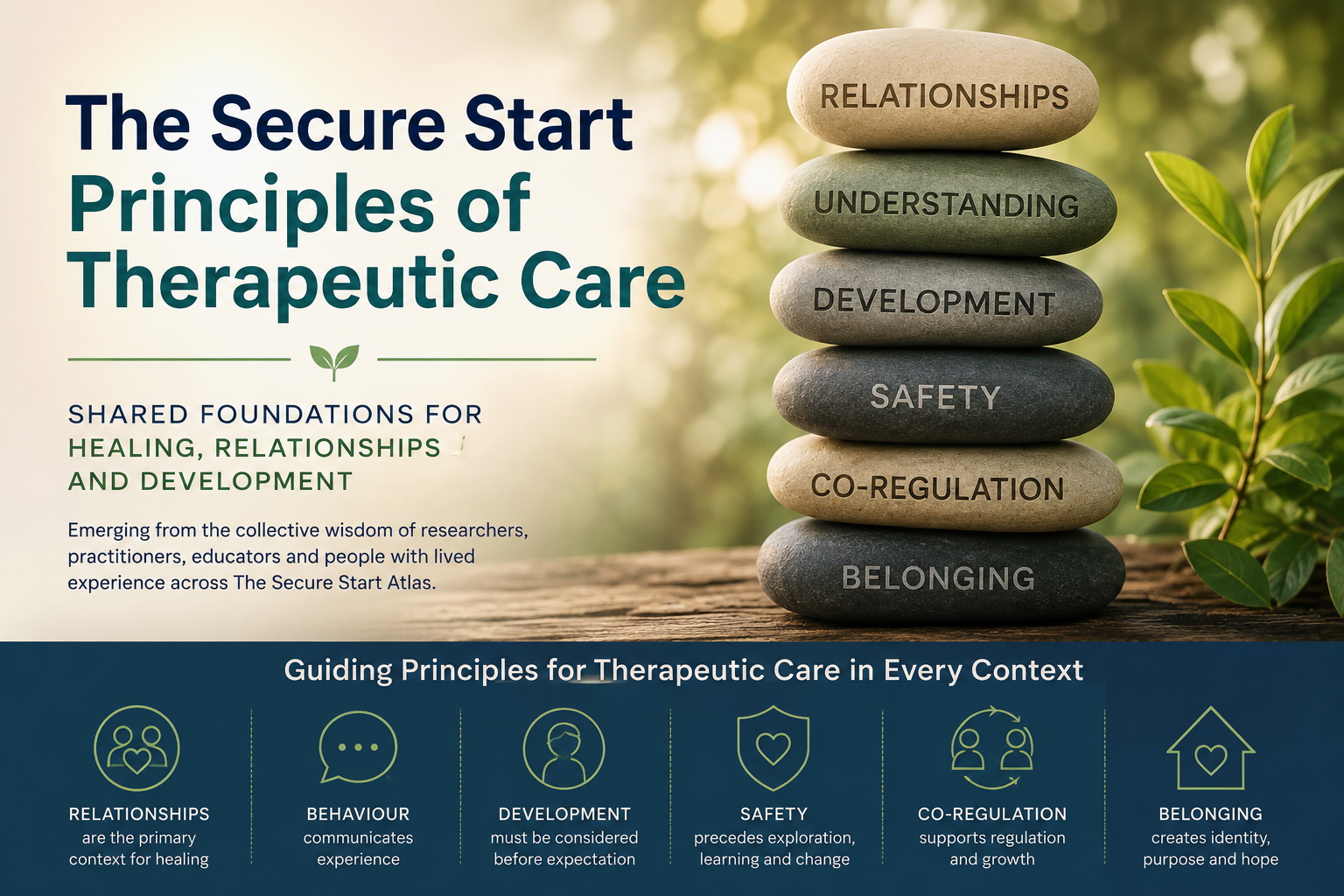
Shared Foundations for Healing, Relationships and Development
The Secure Start Principles of Therapeutic Care represent the recurring ideas that emerge across conversations with researchers, practitioners, educators, organisational leaders and people with lived experience who have appeared on The Secure Start Podcast.
They are not presented as a new therapeutic model.
Nor are they attributed to one person, profession or school of thought.
Instead, the principles reflect areas of substantial convergence across the Secure Start Atlas of Therapeutic Care. Contributors may use different language, work in different settings and draw upon different theoretical traditions, yet many repeatedly return to similar conclusions about what children and young people need in order to feel safe, recover from adversity and continue developing.
The principles provide a foundation for thinking about therapeutic care across:
- families
- foster and kinship care
- residential care
- schools
- psychotherapy
- child protection
- leaving-care services
- professional supervision
- organisational leadership
- policy and service development
They are intended to support reflection rather than prescribe a fixed response.
Therapeutic care always requires attention to the individual child, their relationships, their developmental needs and the context in which care is provided.
1. Relationships Are the Primary Context for Healing
Children develop within relationships, and much of the harm associated with abuse, neglect, loss and instability is relational.
Healing must therefore also be relational.
Therapeutic change does not occur only through formal programmes, assessments or clinical appointments. It develops through repeated experiences of adults who are available, interested, dependable and emotionally present.
Children may not remember every professional intervention they receive.
They often remember:
- who smiled when they saw them
- who remained when things became difficult
- who believed in them
- who noticed what mattered
- who made time for them
- who returned after conflict
- who helped them feel that they belonged
A relationship becomes therapeutic not because it is perfect, but because it is sufficiently safe, responsive and enduring.
In practice, this means:
- prioritising relational continuity
- protecting important relationships where possible
- investing time in connection before expecting disclosure or change
- recognising ordinary interactions as therapeutically significant
- repairing relationships after misunderstandings and conflict
Reflective question
What is this child learning about relationships through their experience of me?
2. Behaviour Communicates Experience
Behaviour does not occur in isolation.
It emerges from the interaction between a child’s development, emotional state, previous experiences, current relationships and immediate circumstances.
Behaviour that adults experience as difficult may communicate:
- fear
- pain
- shame
- confusion
- loneliness
- sensory overload
- loss
- mistrust
- a need for control
- an expectation of rejection
- an attempt to obtain connection
- a neurodevelopmental difficulty
- a capacity that has not yet developed
Understanding behaviour does not mean approving every action.
Nor does it remove the need for boundaries, responsibility or protection.
It means that intervention begins with curiosity rather than judgement.
In practice, this means:
- describing behaviour rather than labelling the child
- considering what happened before, during and after an incident
- asking what need, fear or expectation may be influencing the behaviour
- distinguishing unwillingness from inability
- avoiding language that turns behaviour into identity
- responding to the meaning of behaviour as well as its immediate impact
Reflective question
What might this behaviour be communicating that the child cannot yet express in another way?
3. Development Must Be Considered Before Expectation
Chronological age does not always reflect developmental capacity.
Children who have experienced adversity may have uneven development. They may appear highly capable in one area while requiring considerable support in another.
A young person may be able to:
- cook a meal
- travel independently
- use sophisticated language
- care for younger children
- appear confident
- manage practical tasks
Yet still struggle with:
- emotional regulation
- trust
- planning
- impulse control
- asking for help
- tolerating uncertainty
- understanding consequences
- maintaining relationships
- managing loneliness
Therapeutic care adjusts expectations according to developmental need rather than relying solely on age, appearance or practical competence.
In practice, this means:
- assessing emotional and relational readiness as well as practical skill
- offering support without infantilising the young person
- recognising that apparent independence may have developed through necessity
- providing scaffolding until capacities are genuinely established
- avoiding the withdrawal of support simply because a young person appears competent
Reflective question
Is this expectation appropriate for this child’s actual developmental capacity?
4. Safety Precedes Exploration, Learning and Change
When children feel unsafe, their attention is directed towards survival.
They become more likely to scan for danger, protect themselves, control their environment or react rapidly to perceived threat.
In these states, reflective thinking, learning and cooperation become more difficult.
Safety is therefore not simply the absence of immediate physical danger.
Children also require:
- relational safety
- emotional safety
- predictability
- understandable routines
- trustworthy adults
- protection from humiliation
- confidence that support will remain available
A child may be physically safe while their nervous system continues to anticipate danger.
Therapeutic care seeks to create repeated experiences through which safety becomes increasingly expected rather than merely explained.
In practice, this means:
- maintaining predictable routines
- preparing children for changes
- communicating clearly
- reducing unnecessary uncertainty
- responding calmly during distress
- ensuring that boundaries are understandable and consistent
- recognising that trust develops through experience, not reassurance alone
Reflective question
Does the child experience this situation as safe, or have adults simply decided that it is safe?
5. Co-regulation Precedes Self-regulation
Children do not begin life with the capacity to regulate overwhelming emotion independently.
They develop this capacity through repeated experiences of being regulated with and by other people.
An emotionally available adult receives the child’s distress, remains sufficiently calm, helps make sense of what is happening and responds in a manageable way.
Over time, these experiences become internalised.
The child gradually develops a greater capacity to:
- pause
- think
- tolerate frustration
- recover from distress
- ask for help
- understand emotion
- regulate without immediate adult assistance
Expecting self-regulation without sufficient co-regulation risks asking children to demonstrate capacities they have not yet had the opportunity to develop.
In practice, this means:
- regulating ourselves before attempting to regulate the child
- using tone, posture, rhythm and presence thoughtfully
- remaining available without overwhelming the child
- helping name emotional experience
- reducing demands during periods of high activation
- returning to reflection and responsibility once regulation has been restored
Reflective question
What does this child need from my nervous system before they can make use of my words?
6. Understanding Should Precede Intervention
Professionals and caregivers are frequently under pressure to act quickly.
There may be demands to:
- stop behaviour
- reduce risk
- produce measurable outcomes
- complete plans
- demonstrate progress
- resolve crises
Action is sometimes necessary.
However, intervention without adequate understanding can reinforce the difficulties it is intended to address.
Therapeutic practice requires space to observe, think and develop a meaningful understanding of the child.
This includes considering:
- the child’s history
- their current circumstances
- their developmental capacities
- their relationships
- their internal experience
- the function of behaviour
- the emotional responses they evoke in adults
Understanding and action are not opposites.
Understanding makes intervention more accurate, compassionate and effective.
In practice, this means:
- observing before reacting where safety permits
- developing shared formulations
- bringing together different perspectives
- listening to the child’s account
- recognising uncertainty
- avoiding premature explanations
- reviewing whether existing interventions are based on assumptions or understanding
Reflective question
What do we need to understand before deciding what to do?
7. Curiosity Is More Therapeutic Than Certainty
Therapeutic care requires confidence, but it also requires humility.
Children’s behaviour and emotional lives are complex. Adults rarely know with certainty why something has happened or what a child is feeling.
Premature certainty can close down thought.
Statements such as:
- “They are manipulating us”
- “They just want attention”
- “They know exactly what they are doing”
- “They do not care”
- “They are refusing to engage”
may offer adults a sense of explanation while obscuring the child’s experience.
Curiosity keeps multiple possibilities open.
It allows adults to wonder without abandoning responsibility.
In practice, this means:
- using tentative language
- asking rather than assuming
- distinguishing observation from interpretation
- remaining open to new information
- revising formulations when necessary
- tolerating “I don’t know”
- treating uncertainty as a reason to think more deeply rather than react more forcefully
Reflective question
What else might be happening here?
8. Boundaries Can Be Expressions of Care
Therapeutic care is not permissive care.
Children need adults who can provide protection, structure and leadership.
Boundaries help make relationships and environments understandable. They communicate that adults are paying attention and are prepared to take responsibility.
The therapeutic value of a boundary depends upon:
- why it is being set
- how it is communicated
- whether it is proportionate
- whether it preserves dignity
- whether the relationship remains available
- whether the adult can distinguish protection from punishment
A boundary becomes less therapeutic when it is driven by retaliation, humiliation, fear or the adult’s need to win.
In practice, this means:
- setting limits calmly and clearly
- avoiding threats and public humiliation
- explaining decisions in developmentally appropriate ways
- remaining emotionally available after saying no
- separating the child from the behaviour
- using consequences to support learning and repair rather than suffering
Reflective question
Is this boundary protecting development and relationship, or expressing adult frustration?
9. Repair Is More Important Than Perfection
No therapeutic relationship is free from misunderstanding, disappointment or conflict.
Adults will sometimes:
- misread a situation
- respond too quickly
- become frustrated
- fail to understand
- make decisions the child experiences as hurtful
- be unavailable when needed
The aim is not relational perfection.
It is the capacity to recognise rupture and participate in repair.
Repair communicates that:
- relationships can survive difficulty
- adults can take responsibility
- conflict does not inevitably lead to rejection
- the child’s experience matters
- people can reconnect after getting things wrong
For children whose earlier relationships ended through abandonment, violence, silence or unresolved conflict, repair can be profoundly developmental.
In practice, this means:
- acknowledging mistakes
- listening to the child’s experience
- apologising without shifting blame
- returning after conflict
- helping the child repair harm they have caused
- treating rupture as an opportunity for learning rather than proof of failure
Reflective question
What needs to happen for connection to be restored?
10. Consistency Matters More Than Intensity
Children recovering from adversity are often offered short periods of intensive support.
While specialist intervention can be valuable, development is shaped by what happens repeatedly.
Trust grows through repeated reliability.
Regulation grows through repeated co-regulation.
Self-worth grows through repeated experiences of being valued.
Belonging grows through repeated participation and inclusion.
One extraordinary interaction cannot compensate for an environment characterised by inconsistency.
Small moments, repeated consistently, can gradually alter children’s expectations of themselves and others.
In practice, this means:
- focusing on daily patterns rather than occasional exceptional efforts
- supporting continuity between adults
- maintaining therapeutic principles under pressure
- avoiding rapid changes in approach
- recognising the cumulative value of ordinary moments
- understanding that results may emerge long after the adult’s involvement has ended
Reflective question
What experience are we repeatedly providing this child?
11. Belonging Is a Developmental Need
Children need more than placement, accommodation or service provision.
They need to experience that they have a place in relationships, families, schools, communities and the wider world.
Belonging involves:
- being known
- being remembered
- being included
- being missed
- contributing
- having shared history
- knowing where one fits
- expecting relationships to continue
A child may be surrounded by professionals and still feel alone.
A placement may be stable without feeling like home.
Belonging develops when children experience themselves as meaningful participants in the lives of others.
In practice, this means:
- supporting enduring relationships
- helping children maintain community connections
- creating rituals and shared memories
- including children in ordinary family and group life
- preserving identity and cultural connections
- avoiding language that reduces children to cases or placements
- thinking beyond the duration of formal services
Reflective question
Where, and with whom, does this child experience that they truly belong?
12. Identity Must Be Broader Than Trauma or Care Experience
Children and young people need opportunities to understand what has happened to them.
They also need identities that extend beyond adversity.
A trauma-informed account that explains every aspect of the child through abuse, neglect or placement history can become another form of limitation.
Children are also:
- funny
- creative
- thoughtful
- determined
- curious
- musical
- athletic
- caring
- mischievous
- ambitious
- uncertain
- ordinary
Therapeutic care helps children make sense of difficult experience without allowing it to become the whole of who they are.
In practice, this means:
- noticing interests, strengths and preferences
- recording children’s aspirations as well as concerns
- providing opportunities beyond treatment
- supporting life story and identity work
- challenging stigma associated with care
- helping children imagine futures not determined by statistics or professional expectations
Reflective question
Who is this child beyond the difficulties that brought them to our attention?
13. Children’s Voices Require Relationship and Interpretation
Listening to children is essential.
However, children’s participation cannot be reduced to asking a question and recording the answer.
Children may:
- say what they think adults want to hear
- minimise distress
- protect parents or carers
- fear the consequences of honesty
- lack the language to describe their experience
- hold contradictory wishes
- communicate more clearly through behaviour than words
Genuine participation requires trusted relationships, repeated conversations and careful attention to context.
Children’s words should be taken seriously without being interpreted simplistically.
In practice, this means:
- creating safe and private opportunities to talk
- speaking with children more than once
- explaining how their views will be used
- considering behaviour and emotional presentation alongside words
- acknowledging ambivalence
- avoiding tokenistic consultation
- involving children in decisions that affect their lives
Reflective question
What would this child need in order to communicate their experience safely and honestly?
14. Lived Experience Is a Form of Knowledge
People who have experienced care, trauma, family separation or professional intervention hold knowledge that cannot be obtained through professional training alone.
Lived experience can reveal:
- how policies feel in practice
- which relationships remain significant
- how professional language shapes identity
- why apparently helpful interventions may feel unsafe
- what is missing from formal outcome measures
- what makes support meaningful over time
Lived experience should not be used merely to create emotional impact.
People should not be expected to disclose painful experiences without purpose, preparation, support or appropriate recognition.
Meaningful involvement requires partnership and power-sharing.
In practice, this means:
- involving people with lived experience in design and evaluation
- recognising their expertise
- paying people appropriately for their contribution
- avoiding trauma mining
- including a range of voices, not only those considered successful or presentable
- allowing people control over what they share
- translating testimony into practical and systemic change
Reflective question
Are we genuinely sharing knowledge and power, or simply asking people to tell their stories?
15. Adults Need Support in Order to Support Children
Therapeutic care places considerable emotional demands on adults.
Children may communicate distress through the feelings they evoke in others. Caregivers and professionals may experience:
- helplessness
- anger
- rejection
- fear
- urgency
- hopelessness
- exhaustion
- self-doubt
- pressure to rescue
- pressure to withdraw
These responses are not necessarily evidence of professional failure.
They may contain important information about the child’s experience and the emotional demands of the work.
Adults require relationships and structures that help them process these experiences.
In practice, this means:
- providing reflective supervision
- creating psychologically safe teams
- supporting foster, kinship and residential caregivers
- recognising compassion fatigue and vicarious trauma
- offering practical as well as emotional assistance
- helping adults distinguish their own feelings from those communicated by the child
- avoiding blame when adults ask for help
Reflective question
What does this adult need in order to remain emotionally available to the child?
16. Therapeutic Care Is an Organisational Responsibility
An organisation cannot expect frontline staff to remain calm, reflective and relational while leadership operates through fear, inconsistency or blame.
The values experienced by staff will influence the care experienced by children.
Therapeutic organisations require alignment between:
- stated values
- leadership
- supervision
- policies
- staff relationships
- decision-making
- responses to mistakes
- everyday practice
This alignment is never complete. It requires an ongoing struggle for congruence.
In practice, this means:
- adopting a shared model of care
- ensuring leaders understand the primary task
- creating space for reflection
- responding thoughtfully to incidents
- supporting staff before demanding improvement
- allowing concerns to be voiced
- reviewing whether organisational practices reproduce the experiences children have already suffered
Reflective question
Does our organisation provide staff with the same qualities of care that we expect them to provide to children?
17. Systems Should Respond to Need, Not Ideology
No single form of care is right for every child.
Foster care, kinship care, residential care, family support and specialist services all have important roles.
Placement and service decisions should be based on:
- the child’s needs
- the purpose of the intervention
- developmental readiness
- relationships
- preferences
- culture
- safety
- likely opportunities for growth
Hierarchies that automatically position one form of care as superior may expose children to repeated failure before appropriate support is offered.
In practice, this means:
- assessing placement purpose
- considering residential care as a positive option where appropriate
- avoiding repeated placement disruption
- strengthening families before separation where safely possible
- providing a genuine continuum of care
- measuring quality rather than relying on assumptions about service type
Reflective question
Which environment is most likely to help this particular child grow, develop and thrive?
18. Care Should Continue Beyond Arbitrary Age Thresholds
Development does not end at eighteen.
Most young adults continue to rely on family relationships, practical assistance, financial support and emotional guidance well into adulthood.
Young people leaving care should not be expected to demonstrate greater independence than their peers while having fewer resources and weaker safety nets.
Leaving care should be understood as a gradual relational and developmental transition rather than an administrative event.
In practice, this means:
- maintaining relationships beyond formal placement endings
- offering return options
- supporting housing, education and employment
- addressing loneliness and belonging
- recognising emotional readiness
- avoiding the withdrawal of help as soon as competence is demonstrated
- providing lifelong connection where possible
Reflective question
Would we consider this level of independence reasonable for a young person supported by their own family?
19. Hope Is a Therapeutic Practice
Hope is not passive optimism.
It is expressed through the expectations, opportunities and relationships adults create around children.
Children notice whether adults imagine a future for them.
Low expectations can become self-fulfilling. Children who repeatedly hear that they are difficult, damaged, risky or unlikely to succeed may gradually adopt those descriptions.
Therapeutic adults hold hope when children cannot yet hold it for themselves.
This does not require denying difficulty.
It means refusing to treat current circumstances as a final prediction.
In practice, this means:
- maintaining high but realistic aspirations
- creating access to new experiences
- noticing potential
- avoiding deterministic language
- celebrating growth
- helping children identify interests and dreams
- trusting that relational work may bear fruit later
Reflective question
What future is this child learning to imagine through our expectations of them?
20. Care Is a Moral and Emotional Commitment
Care is more than a task, service or procedure.
It involves responsibility for another person’s welfare.
To care may involve:
- affection
- thoughtfulness
- sorrow
- patience
- protection
- courage
- inconvenience
- boundaries
- advocacy
- persistence
- uncertainty
Therapeutic care cannot be reduced to warmth alone.
At times it requires adults to remain present with pain they cannot immediately resolve.
At other times it requires them to challenge harmful behaviour, oppose poor decisions or accept the emotional burden of responsibility.
Care is demonstrated through the sustained quality of attention given to another person.
In practice, this means:
- taking children’s experiences seriously
- resisting both sentimentality and detachment
- exercising authority in service of the child
- remaining thoughtful under pressure
- advocating when systems fail
- accepting that care is emotionally demanding
- protecting dignity alongside safety
Reflective question
What does genuine care require of us in this situation?
How the Principles Work Together
The principles are deeply connected.
Safety supports regulation.
Regulation makes reflection possible.
Reflection supports understanding.
Understanding improves intervention.
Consistent intervention strengthens trust.
Trust supports attachment and belonging.
Belonging supports identity, hope and exploration.
None of these processes depends upon one person alone.
Children are surrounded by networks of caregivers, professionals, organisations and systems. Therapeutic care becomes strongest when these layers work in alignment.
The principles can therefore be considered at several levels.
The child
What is happening developmentally, emotionally and relationally?
The relationship
What is being communicated and experienced between the child and adult?
The practitioner or caregiver
What does the adult need in order to respond thoughtfully?
The team
How can different perspectives be brought together?
The organisation
What conditions support or inhibit therapeutic practice?
The wider system
Do policy, funding and service structures strengthen or undermine continuity, belonging and development?
Using the Principles in Practice
The principles can be used as a reflective framework in many settings.
During individual reflection
Choose the principle most relevant to a difficult interaction and consider the reflective question attached to it.
In supervision
Use the principles to explore what may be happening for the child, the adult and the wider system.
In team meetings
Consider which principles are being upheld and which may be under pressure.
In care planning
Assess whether proposed interventions support safety, relationship, regulation, development, identity and belonging.
In organisational review
Examine whether staff experience the same relational and reflective values the organisation expects them to provide.
In policy development
Consider how policies will be experienced by children, families, caregivers and practitioners—not only how they appear administratively.
A Living Set of Principles
The Secure Start Principles of Therapeutic Care will continue to evolve.
New podcast conversations may:
- deepen an existing principle
- introduce an important qualification
- challenge an assumption
- identify a missing perspective
- reveal new connections
- support the development of an additional principle
The aim is not to establish a fixed doctrine.
It is to maintain a thoughtful and accessible synthesis of the ideas emerging across the Secure Start Atlas.
The principles should remain open to research, lived experience, practice wisdom and continued reflection.
The Secure Start Principles of Therapeutic Care
Relationships heal.
Behaviour communicates.
Development shapes capacity.
Safety precedes learning.
Co-regulation supports self-regulation.
Understanding should precede intervention.
Curiosity keeps thinking open.
Boundaries can express care.
Repair strengthens relationships.
Consistency creates cumulative healing.
Belonging is essential.
Identity must be larger than adversity.
Children’s voices require trusted relationships.
Lived experience is knowledge.
Adults need support to support children.
Therapeutic care is an organisational responsibility.
Systems should respond to individual need.
Care should extend into adulthood.
Hope is therapeutic.
Care is a sustained moral and emotional commitment.
The Secure Start Atlas of Therapeutic Care
Connecting ideas. Informing practice. Improving lives.
This page forms part of The Secure Start Atlas of Therapeutic Care, a living knowledge resource developed from conversations on The Secure Start Podcast. The Atlas will continue to grow as new contributors, ideas, research and lived experiences are added.